
|
Everett
|
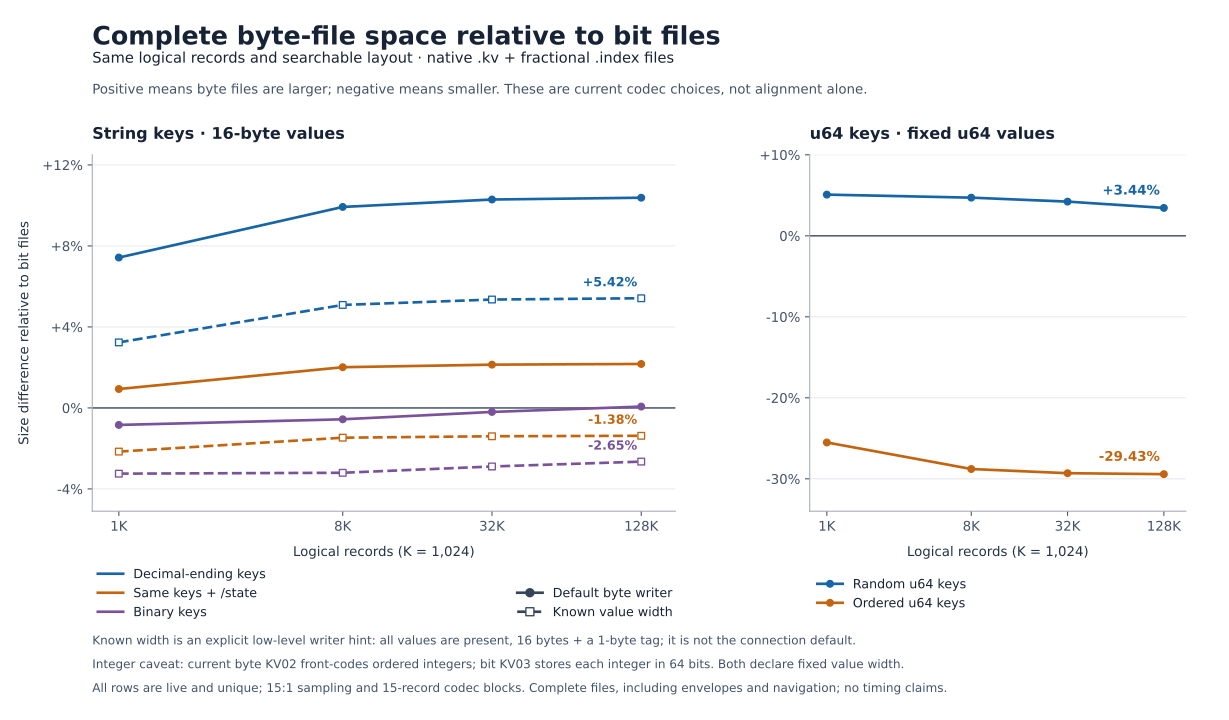
The measured byte penalty is small for random keys and larger values. It is more noticeable when nearby keys differ in their last few bits. At 131,072 rows, decimal-ending string keys with sixteen-byte values cost 10.38% more in the current byte path, or 5.42% more when I explicitly declare their common encoded value width. Binary string keys cost 0.07% more by default; with that same width declaration, the byte files are 2.65% smaller.
Those are complete .kv plus .index sizes for the same logical records and searchable layout. They are not performance results. Integer codec choices matter enough to reverse the ordering, so I keep the actual typed formats and identical-grammar controls separate.
The space plot shows these choices across all four sizes, including the explicit common-width control. A PNG copy and plot provenance are also retained.
I built 1,800 complete files across 200 layouts: five modes, ten datasets and four sizes. Every layout has three disjoint nonempty native files, one shared empty native, all required fractional-index files and enough empty carriers to make the root directly searchable. The two larger native populations are one quarter and one half of the table; a second quarter is a native-only secondary. All modes use 15:1 sampling and fifteen-record codec blocks.
The serializer includes each file's 96-byte envelope, body directory, CRCs, alignment, sparse offsets, rank data, cut LCPs, false-borrow bits, and sort metadata where present. All files were reopened and scanned, all native and borrowed records were compared, and each prepared cascade was probed. Logical oracle SHA-256 identities match across all modes for all forty datasets/sizes. No SQLite metadata, filesystem allocation rounding, retained history or allocator capacity enters these totals.
These fixtures contain present values and unique live keys. They do not model tombstone populations, skewed sort populations, long strings or an entire scheduler history. The harness guide gives the exact construction, codec choices and reproduction commands. The complete tables retain every size and the raw-codec controls.
At 131,072 rows, the totals below count four unique .kv files and six .index files. Positive deltas mean byte files are larger.
| Key / value distribution | Byte native | Bit native | Byte indexes | Bit indexes | Complete byte delta |
|---|---|---|---|---|---|
| Ordered u64 / fixed u64 | 1,452,968 | 2,130,608 | 158,520 | 152,808 | −29.43% |
| Random u64 / fixed u64 | 2,215,504 | 2,130,608 | 213,984 | 218,024 | +3.44% |
| Ordered u64 / 0–512-byte values | 34,511,744 | 34,880,176 | 158,520 | 152,808 | −1.04% |
| Random u64 / 0–512-byte values | 35,272,512 | 34,880,168 | 213,984 | 218,024 | +1.11% |
| Decimal-ending strings / 16-byte values | 2,809,048 | 2,534,592 | 171,088 | 165,288 | +10.38% |
Same keys plus /state / 16-byte values | 3,595,864 | 3,511,368 | 227,376 | 230,608 | +2.17% |
| Binary strings / 16-byte values | 4,576,960 | 4,565,136 | 288,976 | 297,552 | +0.07% |
| Decimal-ending strings / 0–512-byte values | 34,360,632 | 34,090,368 | 171,088 | 165,288 | +0.81% |
Same keys plus /state / 0–512-byte values | 35,147,120 | 35,064,712 | 227,376 | 230,608 | +0.22% |
| Binary strings / 0–512-byte values | 36,127,816 | 36,117,520 | 288,976 | 297,552 | +0.0047% |
The typed byte side is KV02 with sort_list<S>; the bit side is KV03 with bin<tip<S>, sort_undefined>. They have the same single sort and the same logical keys and values, but their physical grammar differs. The integer sort uses unsigned_key<64> and either unsigned_value<64> or string_value<>. The string sort is the built-in unsorted<std::optional<std::string>>.
KV03's integer codec writes all 64 key bits. KV02 front codes their ordered bytes. That is why the ordered-integer row strongly favors the current byte path: it is not a benefit inherent in byte alignment. The same raw KV02 front-coding grammar on both sides instead makes byte files 13.11% larger for ordered u64 keys and fixed u64 values. For random u64 keys, those raw byte files are 1.11% smaller. A fixed-width FC integer codec would be another choice; this experiment does not implement it.
The fixed integer sorts declare their widths on both sides, so both remove values from the Elias–Fano universe and omit redundant value lengths. Ordinary optional-string sorts promise variable size even when this particular batch has equal-length values. The current KV03 writer observes a common encoded width; the incremental KV02 writer requires that width before construction.
I therefore added typed-byte-known, which passes the supported width of seventeen bytes to the byte writer for these all-present, sixteen-byte string values. The presence tag is included. It produces real KV02 files and checks that every value fits. This is an explicit low-level writer hint, not an automatic option of connection. It is a file-local construction choice, not a promise that future tombstones also occupy seventeen bytes.
| 131,072-row string fixture | Default byte total | Width-known byte total | Bit total | Width-known byte delta |
|---|---|---|---|---|
| Decimal-ending keys | 2,980,136 | 2,846,112 | 2,699,880 | +5.42% |
Same keys plus /state | 3,823,240 | 3,690,512 | 3,741,976 | −1.38% |
| Binary keys | 4,865,936 | 4,733,728 | 4,862,688 | −2.65% |
The explicit width removes 131,072 bytes of value lengths and another 1,136–2,952 bytes of EF storage in these fixtures. Index files are unchanged. The remaining difference cannot be blamed on a redundant value-length field.
The decimal-ending keys share a long prefix and often differ near the end of the final byte. Ordinary bit front coding already uses that information. It is not only compressing counts: in the 131,072-row typed fixture, native key literals take 1,398,840 bits in byte mode and 649,528 bits in bit mode, a saving of about 5.72 bits per row. No extra entropy or order-preserving compression was applied to the input strings.
The width-known native byte stream uses 2,097,152 framing bits; the bit stream uses 1,438,440. Conversely, the byte presence tag plus sixteen raw bytes takes 136 bits per value, while KV03's one-bit tag, exponential-Golomb length and sixteen bytes take 138. Keeping these terms separate explains the result more clearly than calling every difference a bit-versus-byte cost.
The /state suffix changes that balance. Every changed prefix must repeat those trailing bytes, and the bit suffix/backtrack counts become larger. Byte LEB128 still fits those counts in one byte. With a known value width, byte storage wins this fixture despite retaining fewer bits of each key. The high-entropy fixture similarly spends most of its key space on literals.
Explicit bit-key codecs also exist: fc_bit_key<> accepts non-byte-length keys, and unsigned_key<N> can describe a non-byte integer width. Their existence does not mean the ordinary string examples apply an additional key compression scheme. An order-preserving dictionary or other compressed key alphabet could change the tradeoff; none was measured here.
The ordinary typed byte penalty for decimal-ending keys and sixteen-byte values grows from 7.43% at 1,024 rows to 10.38% at 131,072 rows, as fixed file metadata becomes less prominent. Random u64/fixed-u64 moves from +5.08% to +3.44%. Binary-string/fixed-value files move from −0.84% to +0.07%. The variable-value string cases remain within about one percent across the entire measured range. These are distributions, not a universal bound.
The per-file CSV gives all byte components. In the width-known decimal-ending case, byte EF arrays total 9,840 bytes; bit EF arrays total 12,536 bytes. This experiment keeps ordinary EF everywhere and makes no claim about the speed or complete-file size of a different offset format.
For a NUL-free suffix shorter than 128 bytes, the existing suffix length is one byte. A one-byte terminator also costs one byte. It changes scanning and skipping, but gives no space saving for those suffixes. Known fixed-width integers can infer their missing suffix width from the retained prefix instead; that is a stronger specialization than replacing a length by a terminator.
For arbitrary binary strings, I modeled 00 ff for an embedded zero and 00 00 for the terminator, keeping the existing FC cuts. Replacing only the suffix-length field adds one byte per suffix plus one per zero in these short-suffix fixtures: 140,437 bytes across all native and index streams for the raw decimal-ending case, or 148,720 bytes for the raw binary case. The typed sort discriminator can add a few extra escaped zeros.
That is an exact stream model, not a supported new file. It does not recalculate EF offsets, byte alignment or checksums and is not counted as a complete-file result. A terminator also gives up direct skipping from an explicit suffix length unless another piece of the grammar supplies the boundary.
Byte alignment looks affordable for many of these tables, especially when the sort supplies a fixed value width and high-entropy keys dominate. Short final bit differences are a real strength of bit front coding. I would keep those facts distinct from current generic wrapping costs: a byte-native sort grammar could remove controls whose lengths the sort already knows, and a fixed-width FC integer codec could improve either profile. Those are implementation opportunities, not performance results from this space experiment.
Measured source: 9fbf906, with production headers from b2b893c. Initial source 09627d4 produced a subset of 1,152 files; the expanded run reproduced every one of their file lengths and SHA-256 identities. The added decimal-ending fixture and explicit-width control have separate rows. No original result was silently replaced.
Release and ASan/UBSan each passed five CTest cases at 1,024 rows, covering all ten datasets per case. An independent reviewer also parsed 24 retained byte native files, reconstructed 6,144 records against their logical oracles, checked the width-17 headers and residual universes, and checked the NUL model against constructed escaped suffixes, including embedded zeros.
Metadata and header hashes, file hashes, logical fixtures, checks, summaries and comparisons are retained. analyze.py regenerates the summaries and tables from the raw CSVs and checks exact component totals and matched logical identities. No timing measurement was collected under the concurrent integration build.
1.9.8