Agent operation reference
Compact reference for the editor MCP server. Start with the skills catalog for task workflows or session tools for the user guide. tools/list is authoritative for the running version’s schemas; fields below omit JSON type boilerplate.
Notation: ? marks an optional argument; {} means no arguments. R is read-only, W changes editor/files/settings, X can execute/control programs, Q asks the user. These are descriptive categories: actual policy is selected per tool in Options > Agent Permissions. Read-only tools default to Enable; other tools default to Prompt. editor_settings can write, so even its read form uses that tool’s policy.
Protected content policy
One policy classifies editor authority and protected UI content. It applies to agent-facing reads and actions regardless of the human's Streamer setting. Turning Streamer mode off does not grant an agent access. The path predicate lives in Hide.Privacy; resource and UI projections consume it through Hide.GuestAccess and the model. Path resolution belongs to service workers, not rendering.
Authority paths are the host-registered canonical global/project configuration files, editor session/recovery store, agent configuration/resume records and live session endpoint directory, including descendants of registered roots. Any file whose basename is thc.toml (case-insensitive) is also authority. Component-wise containment excludes similarly prefixed siblings; known symlink paths must be resolved before admission. This is one host-maintained set, not a per-tool choice.
Protected UI content includes human conversation/question drafts, pending approval controls, provider/session credentials and sensitive configuration values. Agents may inspect nonsensitive settings but cannot change their own permissions, submit a human's answer, or type into a human composer. Generic reads of approval and Git-review buffers are refused; structured Git tools provide separately checked results. Public conversation transcripts are distinct from their protected spans. Plugin windows remain private until the host accepts explicit semantic access. Recovered unsent plugin input stays private through Save and restart. While a saved private document remains open, its canonical path is also protected from agent file reads, search and filesystem changes. New views of that path inherit the flag; source rendering reads it directly without walking other buffers per cell.
Structured records whose owning source is an authority path are omitted as records, including their path and diagnostic body. Screens preserve geometry with masked cells and safe titles. Filter before pagination and serialization; delayed workers must recheck the current policy before publishing or applying their result. Apply the rule to provenance rather than scanning unrelated source text for strings that look like secrets. Per-surface sections below describe output shape and additional operation constraints, not alternative definitions of authority.
This is an editor boundary, not a secret scanner or an OS sandbox. Approved terminal/build programs, language servers, debugger evaluation and trusted native plugins execute with their process account's access. Their arbitrary output cannot be made confidential merely by recognizing protected editor paths. Documentation reads use a bounded declared corpus, not automatic classification of every word.
Buffers, files and search
| Tool | Kind | Arguments | Result / contract |
|---|---|---|---|
list_buffers |
R | {} |
Buffer IDs, paths, revisions, dirty state; includes untitled buffers |
list_windows |
R | {} |
Window IDs, titles, buffer IDs, rectangles, active window and panels |
read_buffer |
R | bufferId?, startLine?, lineCount?, byteOffset? |
Live text; 200 lines default, 1000 maximum. Binary: up to 4096 hex bytes. Defaults to active buffer |
read_window |
R | windowId?, startLine?, lineCount? |
Readable prepared text; 200 lines default, 1000 maximum, 131072 characters. Logical window-text coordinates; protected spans masked. Defaults to active window |
read_selection |
R | windowId? |
Up to 131,072 selected characters and cursor offsets; truncated reports a larger selection. coordinateSpace is source or rendered-markdown. Defaults to active window |
workspace_project |
R | {} |
Project root, Cabal package file, active source, unsaved buffers, existing Cabal component/dependency graph |
workspace_search |
R | query, trackedOnly?, offset?, limit? |
Literal line matches with live-buffer substitution; tracked-only or ignore-respecting workspace search |
editor_file |
W | action, bufferId?, windowId?, path?, revision?, dirtyAction? |
open, save, close; save/close require current revision. Dirty close requires save or discard |
buffer_apply_diff |
W | buffers: [{bufferId, revision, diff}] |
1–16 strict diffs applied together or none, Undo per changed buffer, no save; ordered results |
workspace_files |
W | operation, path, to? |
mkdir, create_file (empty), delete, rename; only rename takes to |
Search: query is 1–256 characters on one line; offset 0–9999; limit 1–1000 (default 100). Skips binary/files over 1 MiB; caps the scan at 32 MiB and 10,000 files/matches. Inspect truncation flags. Filesystem mutations stay inside the project, refuse overwrite/dirty descendants, protect Git metadata and symlink endpoints, and do not recursively delete directories. Save uses disk-conflict checks. These reads use the protected content policy.
read_window reads an installed prepared text body, including a stopped conversation. Use read_buffer for source files. Rows/Details windows do not provide this text projection. A refresh or close before capture rejects the request; an admitted immutable snapshot remains readable after close. Permission is checked by the same owner as buffer reads. The result has window metadata, not a fabricated buffer ID or source revision.
workspace_project.cabalPlan reads only dist-newstyle/cache/plan.json; it does not invoke Cabal. status distinguishes available, missing, invalid, too-large, and unavailable. Available results include compiler/Cabal versions, plan modification time and age, package unit IDs/names/versions/type/style, local component references, and Cabal's depends/exeDepends edges. Nested Custom Setup components retain their separate dependencies. Package source roots are workspace-relative; external/protected paths, repository URLs, flags and compiler arguments are omitted.
freshness.status is stale when known manifests are newer or have unsaved edits, otherwise unknown: timestamps do not establish that a plan matches the current source or configuration. Check dependenciesKnown, graphComplete, omittedUnits and truncatedUnits before treating the result as complete. Reads stop at 8 MiB and inspect at most 4096 units; graph output is capped at 512 KiB and the full response at 1 MiB. Truncation removes whole units, retaining every reported unit's emitted dependency edges, which may refer to omitted units.
History
| Tool | Kind | Arguments | Result / contract |
|---|---|---|---|
editor_history |
R | bufferId, direction?, offset?, limit? |
Diff previews, newest first, for steps that would be applied; no mutation |
editor_undo |
W | bufferId, revision, direction?, steps? |
Apply undo/redo atomically; no save; returns revision and remaining counts |
direction is undo (default) or redo. Preview offset 0–100, limit 1–10 (default 5); apply 1–100 steps (default 1). Insufficient history/stale revision fails without edits. Binary previews describe byte changes.
Haskell language service and Messages
| Tool | Kind | Arguments | Result / contract |
|---|---|---|---|
workspace_diagnostics |
R | offset?, limit? |
HLS/build/Messages snapshot with positions and reported/current revisions |
inspect_symbol |
R | action, plus position or page arguments below |
Browse type, definitions and references through caller-owned pages |
lsp_hover |
R | bufferId, line, column, revision? |
Hover text and type information |
lsp_definition |
R | bufferId, line, column, revision? |
Definition locations |
lsp_type_definition |
R | bufferId, line, column, revision? |
Type definition locations |
lsp_references |
R | bufferId, line, column, revision?, includeDeclaration? |
Reference locations; declarations included by default |
lsp_document_symbols |
R | bufferId, revision? |
Document symbol structure |
lsp_rename |
W | bufferId, revision, line, column, newName |
Apply HLS rename to live buffers; reject stale source; no save |
lsp_code_actions |
R | bufferId, revision, line, column, endLine?, endColumn? |
List up to 128 action IDs with title/kind/preference and disabled reason; includes current intersecting diagnostics |
lsp_apply_code_action |
W | bufferId, revision, actionId |
Consume a listed action once; apply checked edits and advertised HLS commands; report partial command results |
inspect_symbol shares the symbol inspector with the user. Start with {"action":"inspect","bufferId":1,"line":5,"column":15} (optionally include revision). The result contains a page token, available views and rows. Use view with page and view, follow with page and a zero-based row, or back with page. discover lists this caller's pages and can check a bufferId, line, column position without contacting HLS.
Rows and continuation actions belong to the returned page. hasMore indicates another page; follow its More… row. report.omittedAtLeast is a lower bound on excluded locations, including those beyond the scan limit. Tokens expire after 15 minutes or when the source changes, closes, or becomes private. Referenced-file privacy is checked again before returning results. Following a source row returns a checked location; it does not move the user's caret.
Calls synchronize unsaved Haskell text. Editor input positions use 1-based Unicode code points; raw LSP results use 0-based UTF-16. Responses identify the source revision. Diagnostic messages are capped at 8192 characters. Code-action ranges default to the cursor; supply both end coordinates for a selection. A new action list expires previous IDs. Application requires the original source revision and unchanged affected files, excludes protected files and other projects, and never accepts caller-supplied edits or commands. Commands must be returned by the chosen action and advertised by that HLS process. A literal edit is applied before its command. HLS text edits affect buffers without saving; commands themselves can have server-side effects, such as evaluating doctests. File creation/deletion operations and unsolicited edits are refused.
Each command result includes succeeded, commandSucceeded, applied, appliedBatches, partial, error, and changed buffer revisions. A successful command response does not override a rejected edit. Each accepted edit batch is atomic; the whole command is not. Earlier accepted edits remain if a later batch, the command, or the waiting client fails. Completed commands, including error responses, reuse the initialized HLS process. Cancellation sends $/cancelRequest and rejects further edits while retaining the command slot until the terminal response. Only a broken transport or cancellation that has not settled within two seconds restarts HLS and invalidates its action IDs. At most one command runs per project client, with at most 128 accepted edit batches and a 30-second request deadline. LSP does not attach an originating command ID to workspace/applyEdit: the editor admits edits during the serialized command interval and checks their paths and revisions; this is not isolation from a malicious language server. appliedBatches counts accepted batches, including empty or no-op batches; buffers lists only changed buffer revisions.
Build, test and execution
| Tool | Kind | Arguments | Result / contract |
|---|---|---|---|
build_status |
R | {} |
Active job/last completion, exact job ID, semantic window ID when open, retained character count/truncation, actual exit code |
build_output |
R | jobId, offset?, limit? |
Combined command echoes/stdout/stderr for that job; offsets count Unicode characters in the retained tail; default/maximum 32768 characters |
build_start |
X | action, toolchain?, target?, arguments?, terminal? |
compile, make, run; THC or GHC; overrides apply to this job |
build_stop |
X | {} |
Stop captured build/run; keep output and completion status |
test_start |
X | target?, toolchain? |
Cabal test job; supported toolchain GHC |
test_status |
R | {} |
Cabal suite outcomes, explicit TAP 13 test points, process status and compiler diagnostics |
terminal_list |
R | {} |
Shared Ghostty terminal IDs, buffer IDs and exit codes |
terminal_start |
X | command, args?, cwd?, outputByteLimit? |
Executable plus argument array; no implicit shell; opens window and returns terminal ID |
terminal_output |
R | terminalId, offset?, limit? |
Retained output and exit code; at most 128 KiB per call |
terminal_input |
X | terminalId, text |
UTF-8 input, including control characters |
terminal_stop |
X | terminalId |
Terminate process; keep output window |
Builds require saved source buffers. Build/tests share one job slot. Read build output through build_output using the exact jobId from build_status. The last job remains readable after completion or window closure; starting a new job expires its ID. An already admitted read returns its captured snapshot with the original job ID. The owner reuses its read-only text view geometry with a fresh content lifetime for a new job, without a source buffer ID. Checkpoints retain the output as an inert ended view, without restarting a process or restoring a live job ID. Closing it does not stop the process or let late output reopen it. Terminal output offsets refer to the retained tail; truncated reports discarded earlier output. Execution runs with the editor account’s access. Captured job output is readable under its own tool permission; it is not scanned for secrets. This grants no access to other plugin windows. UI privacy masks are not an OS execution sandbox.
test_status recognizes TAP 13 on stdout beginning with TAP version 13. It reports top-level test numbers, names, pass/fail, skip reasons, TODOs, and unexpected TODO successes. Each stream reports its planned and observed counts and whether it is complete, incomplete, invalid, or bailed out. Nested subtests and YAML diagnostics remain in captured output. Stderr never supplies test points. At most 500 cases and streams are returned, with truncation flags; failures beyond the case limit still fail the run. Missing/truncated output cannot establish completeness, and process failure always wins. Other runners retain suite-level results without guessed cases.
Debugging
| Tool | Kind | Arguments | Result / contract |
|---|---|---|---|
debug_status |
R | {} |
Adapter readiness, stopped state, generation, selected frame, follow mode, sourcePreparation (idle / preparing / ready), capabilities, breakpoints, recent output, terminated, finishing, nullable exitCode |
debug_present |
W | follow?, view?, generation? |
Set automatic UI following; reveal source, stack, scopes or output from the shared session |
debug_launch |
X | adapterConfig?, port? |
Configured THC target or general DAP JSON config; refuses an already active session |
debug_attach |
X | host?, port? |
Loopback adapter; defaults to 127.0.0.1:4711 |
debug_control |
X | generation, command |
continue, next, stepIn, stepOut, pause, disconnect; acceptance is not a stop |
debug_assist |
X | command, generation?, goal?, maxSteps?, budgetMs? |
start, pause, stop, status, reveal; bounded assisted investigation of the shared debugger |
debug_set_breakpoints |
W | generation, bufferId, lines |
Replace that buffer’s source breakpoint set; pending/verified state, sourceModified |
debug_inspect |
R | generation, request, threadId?, frameId?, variablesReference?, sourceReference?, start?, count? |
threads, stackTrace, scopes, variables, source; handles depend on request |
follow: false keeps automatic stops in the background. follow: true follows future stops. An explicit view requires current generation; source/stack/scopes require a stopped, configured session. Reveal a view without changing follow mode by omitting follow. This does not launch or resume a separate debugger.
debug_assist starts only from a ready, paused generation. Supply goal and that generation; maxSteps defaults to 20 (1–100), budgetMs to 60000 (1–300000). Mutations retain the exact initiating caller. Caller retirement, manual debugger input, stale state, provider failure and exhausted budgets end assistance. Pause/stop request a target pause without disconnecting; status reads progress and retained evidence, and reveal presents it without resuming. A successful start is acceptance, not evidence of investigation. Inspect the observations and reported limits before drawing a conclusion. The supplier cannot force lazy references or evaluate expressions. Use this tool rather than typing into the human assistance dialog, so the run retains your lifetime.
Refresh generation after execution changes. Stack/variable inspection requires a stopped target. Inspection pages default to 100 entries, maximum 1000. Breakpoints use 1-based lines, at most 1000. See the debugging skill, also published as hide://debugging through MCP resources.
Git
| Tool | Kind | Arguments | Result / contract |
|---|---|---|---|
workspace_git |
R | view, path? |
status or diff; disk changes and unsaved buffers reported separately |
editor_show_diff |
W | from, to?, path? |
Start a filtered commit-range diff window; returns accepted and jobId, then poll git_operation_status |
git_fetch |
W | — | Fetch the selected repository’s configured default remote; returns accepted and jobId |
git_pull |
W | — | Fetch configured upstream, check incoming changes, then fast-forward only |
git_merge |
W | ref |
Merge a named local or remote-tracking branch with checked incoming paths |
git_review |
R | — | Start a complete saved-change review; poll for diff, complete, and a one-time reviewId |
git_commit |
W | reviewId, message |
Commit all reviewed saved changes using ordinary Git staging and hooks |
git_operation_status |
R | jobId? |
busy, job state/exit code, complete review, or commit head and reviewedTreeMatched |
Diff text is capped at 128 Ki characters. A path filter is a literal file path, not a Git glob/magic pathspec. Whole-repository diffs apply the protected content policy, including Git-detected rename/copy destinations derived from them; omittedFiles reports a count without their names. editor_show_diff applies the same policy to the diff between two commits, excluding the working tree. Its window names the resolved commits and any omitted-file count. Patch capture is capped at 1 MiB of UTF-8, with a visible truncation marker, and cannot be approved as a commit review. The work runs in the shared Git worker; a successful job means the prepared window was displayed. Changing the workspace or private paths before adoption discards the result. Repeated calls replace the same window. Ranges too wide for complete rename/copy tracing or its bounded path inventory are refused. Agent mouse/key input cannot open the unrestricted human Git review or commit dialog; use workspace_git for filtered review. workspace_search with trackedOnly: true searches tracked source. Commit-history search is not exposed as an agent tool.
Each Git tool has its own permission policy. Fetch shares the human Git operation slot, permits unsaved editor changes, and does not change working files. It accepts no remote URL, refspec, shell, or configuration overrides. Acceptance does not imply success: poll status for completion. The latest 16 agent jobs remain queryable for this session; omit jobId for the latest. busy also includes human Git operations. A launch failure has state: "failed" and a null exit code; a process exit reports its actual code. Transport output, URLs, and raw errors are not returned or placed in agent fetch output buffers. Normal Quit waits for the active operation; session teardown cancels and reaps the active Git process.
git_pull and git_merge use the same job slot. Both require saved editor buffers and a clean index/worktree, and refuse unfinished Git operations or hidden/sparse index entries. Pull fetches the configured default remote, then checks the configured upstream and performs an explicit fast-forward-only merge; it does not rebase or honor an automatic stash setting. Merge accepts a local or remote-tracking branch name (or its full refs/heads/ / refs/remotes/ name), not arbitrary revisions, URLs, refspecs, or options. Ambiguous and symbolic names are refused. Both pin the target commit and recheck the selected repository, HEAD, and authority policy before mutation. Typing while fetching prevents the merge; typing while Git runs preserves the unsaved buffer during reload.
Incoming protected paths, their ancestors, Git-detected private rename/copy sources, and changed symbolic links or submodules are refused. Unchanged tracked private configuration does not block safe changes. Protected differences between current HEAD and the target are also refused, even if a particular merge would leave them untouched; this prevents HEAD-side renames from redirecting incoming edits into private files. Agent merges disable Git's directory-rename propagation. Ignored local files are not overwritten. Normal configured Git hooks and merge drivers still execute; the path checks do not sandbox those programs. Status includes phase, head, fetchExitCode (pull only), and conflicts (count, or null if inspection failed). The ordinary exitCode is the merge exit, a failed fetch's exit, or null when preflight/launch prevented execution. A failed merge can leave conflict files and merge state; no automatic reset or abort discards them. A successful fetch remains effective even when the following merge is refused. No tool pushes.
git_review and git_commit also return acceptance and a job ID first. A review is a composite read operation: its successful exitCode: 0 denotes a completed review, not a single subprocess exit. Fetch and commit report actual process exit codes. A review covers staged, unstaged and untracked saved changes, with the same binary notices and content hashes as the human Git review. There is no partial commit or separate staging requirement. Both tools refuse dirty editor buffers. A review is refused if private changes (including Git-detected rename/copy lineage) would be omitted, its text exceeds 128 Ki characters, its private snapshot exceeds 1 MiB, or classification exceeds 10,000 files. An unchanged tracked private configuration does not block a safe review. No truncated or omitted review receives a committable ID; a clean repository has no commit ID.
Only the most recent complete review ID is valid. A commit attempt consumes it, rechecks the current privacy policy, and refuses changed HEAD, index or file contents. Raw snapshots remain server-side. Commit uses the existing whole-repo git add -A and normal Git hooks. Failure can leave reviewed changes staged; files are not rolled back. Ordinary hooks can alter files or the committed tree: reviewedTreeMatched: false reports a mismatch, and null means no successful comparison. head reports the observed resulting commit when available, including after a failed commit. A successful exit is retained even if that follow-up inspection fails. Hook output and raw errors are suppressed.
Windows, panels and binary navigation
| Tool | Kind | Arguments | Result / contract |
|---|---|---|---|
editor_layout |
R | {} |
Character-cell resolution, window rectangles, modes, cursors and docks |
editor_navigate |
W | windowId?, bufferId?, path?, line?, column?, byteOffset? |
Focus/open and navigate; no save; byte offsets require hex mode |
editor_arrange |
W | action, windowId?, x?, y?, width?, height? |
tile, cascade, split_vertical, split_horizontal, focus, move, resize, zoom, pin, unpin |
editor_panels |
W | files?, messages?, filesWidth?, messagesHeight? |
Set visibility/dock dimensions; panel must be visible to resize |
editor_mode |
W | mode, windowId?, bufferId? |
text or hex; preserve bytes; refuse invalid UTF-8/NUL in text mode |
Coordinates are 0-based character cells, text locations 1-based, byte offsets 0-based. Geometry obeys screen limits and docking; use returned rectangles. Files width is at least 16 cells; Messages height at least 3, within available screen space. Split windows share their buffer and undo history.
pin and unpin apply to terminal windows. Pinned terminals and Messages share one bottom panel; messagesHeight resizes it even when the Messages tab is hidden. editor_layout reports each window's pinned, visible and focused state and the panel's selectedWindowId (null for Messages). Focusing a hidden terminal selects its tab. Unpin before moving, resizing, zooming or splitting that window; tile/cascade leave pinned terminals in place. These operations preserve the running terminal and its IDs.
Screen and input
| Tool | Kind | Arguments | Result / contract |
|---|---|---|---|
editor_screen |
R | image? |
Colorless text grid, optional PNG, readable/clickable cell masks, command/key permissions |
editor_input |
W/X | events |
1–64 sequential input events; returns applied count, exit flag, error, text copied by the agent and settings |
clipboard_write |
W | text |
Write supplied text and queue frontend copy; never read existing clipboard |
Input event forms:
{"type":"key","key":"F3","mods":[]}
{"type":"paste","text":"supplied text"}
{"type":"mouse","action":"down","x":10,"y":5,"button":0,"clicks":1,"mods":[]}
{"type":"mouse","action":"up","x":10,"y":5,"button":0}
{"type":"modifiers","mods":["ctrl"]}
{"type":"blur"}
Mouse actions: down, up, move, wheel-up, wheel-down; button 0 left, 2 right. Modifiers: ctrl, alt, shift. Keys: characters, Enter, Escape, Tab, ArrowUp/Down/Left/Right, Home, End, PageUp, PageDown, Backspace, Delete, Insert, F1–F24. Paste is capped at 64 Ki characters per event. Input is not transactional: inspect partial results before retrying.
The host identifies input from an agent. Each batch starts without human clipboard, drag or key-prefix state; gestures may span events within the batch. Agent input cannot submit chat as the person, answer its own questions/approvals, modify agent settings/permissions or toggle Streamer mode. Generic reads and screen captures also protect drafts, authority files and session keys.
Screen capture is capped at 32,768 cells; PNG at 4 megapixels/2 MiB. PNG uses the bundled bitmap font, excluding OS chrome, CRT and native Unicode shaping. Clipboard text is capped at 1 MiB UTF-8 with no NUL; frontend permission can prevent OS export even after queueing succeeds.
Agent sessions and coordination
The primary conversation receives these tools through its authenticated editor server. Children receive an editor server for their own workspace and an agents server for coordination. Caller identity is assigned by the host; tool arguments cannot select another sender or redirect editor calls to another workspace.
| Tool | Kind | Arguments | Result / contract |
|---|---|---|---|
agent_directory |
R | {} |
Named agents, stable IDs, parents, state, workspace, limits and advertised model/effort choices |
agent_spawn |
X | name, task, context?, sourceAgentId?, model?, effort?, workspace? |
Create child, queue its task, return metadata and message ticket; no display focus change |
agent_rename |
W | agentId, name |
Rename self or another agent; stable ID and rename attribution remain |
agent_message |
X | agentId, text |
Queue attributed message; return ticket |
agent_wait |
R | agentId, ticket, timeoutMs? |
Wait 0–60,000 ms, default 30,000; timeout reports running without cancelling |
agent_cancel |
X | agentId |
Cancel current/queued messages; human or ancestor only; keep session |
agent_end |
X | agentId |
End session and descendants; human or ancestor only; retain history and worktrees |
agent_history |
R | agentId, after?, limit? |
Retained events; nextAfter continues, dropped counts discarded older events |
agent_search |
R | agentId, query, after?, limit? |
Literal, case-insensitive search of retained events |
Names are unique ignoring case, at most 80 characters without controls. Tasks and messages accept at most 65,536 characters. History pages default to 50 entries, maximum 100; search queries accept at most 4096 characters. Agent IDs remain stable when names change. A parent occupies its child's user seat; messages from other agents remain peer messages, not human instructions.
context defaults to fresh. fork requires sourceAgentId, caller ownership and actual provider fork support; it never silently starts a fresh conversation. Choose model and effort only from provider-advertised choices.
workspace defaults to {"mode":"worktree"}: a separate checkout of the caller's committed HEAD, detached unless a branch is specified. Optional ref, branch and name retain their normal worktree meanings. Unsaved/uncommitted parent edits are not copied. Git is required; failure never falls back to shared mode. Its editor runs without a display until opened, with separate buffers, build jobs, terminals and debugger. Explicit {"mode":"shared"} opts into the parent's editor and existing job slots. The human New Agent dialog creates a shared child. Ending an agent does not delete its worktree.
Global [editor.agents] sets max_agents (default 8, range 1–64, including the primary) and max_subagents (default 4, range 0–64 direct children per agent). Project thc.toml may lower these ceilings; agents cannot raise them. Both limits are checked at spawn. See configuration.
Tools > Agents or Window > Agents opens the directory. Conversation shows live child messages, retained tool details and a protected human composer. Human messages to parent-controlled children retain peer attribution. Drafts, transcripts and view positions survive switching and editor recovery. Workspace opens the associated editor; Reconnect explicitly loads a recovered provider without replaying queued work. The human can change an idle child's advertised model/effort through its title menu and steer a reply when supported. Context usage is shown only when supplied by that child. These controls do not add a writable agent-settings MCP tool. agent_settings reports Primary's configuration and labels that scope, even when a child conversation is selected.
Conversation and settings
| Tool | Kind | Arguments | Result / contract |
|---|---|---|---|
ask_user |
Q | question, choices?, allowMultiple? or questionId alone |
Create an inline question and return pending immediately; retrieve its owned pending/answered/cancelled result |
agent_settings |
R | {} |
Public provider/model/config choices, connection/steering state, context usage and global/project guidance |
environment_get |
R | names? |
Effective subprocess environment; credentials/authority values redacted; missing names null |
environment_set |
X | values, scope? |
String sets, null unsets; session/project/global; affects new processes; project overrides global; protected variables denied |
editor_settings |
W | settings?, defaults? |
Read current state, change session settings or merge future startup defaults |
Questions: 1–4096 characters; up to 12 choices of 1–256 characters; allowMultiple must be false. One pending question. Creating it follows the configured permission policy, then returns questionId and status: "pending". Retrieving that ID requires the same authenticated caller/provider incarnation; it does not prompt again, but current Disable policy still applies. Pending results reveal neither the draft nor the current choice. Answers require explicit human submission and are limited to 65536 characters.
The submitted answer is queued once to the original live Primary Conversation provider through its normal query queue. Authenticated calls made without a live provider are poll-only. Anonymous calls, including current worktree-child editor bridges without attributed credentials, are refused. Replacement or disconnection invalidates delivery to that provider. Up to 64 terminal results are retained in memory; old IDs expire. There is no timeout-to-answer or implied approval: the agent can continue independent work while the human decides. Agent settings omit argument/environment values and session keys, returning only argument count and environment names; secret-labelled settings are redacted.
settings: appearance (light, dark, system), screenMode (3, 259), columns (40–512), rows (12–256), wordStar, blinkCursor, crtFilter, pixelateUnicode, materialIcons, macKeySymbols, hapticFeedback. Haptic feedback is off by default and applies only to native Mac dialog buttons. Selecting a mode defaults to its 80×25/80×50 grid unless dimensions are supplied. defaults additionally accepts backend (terminal, auto, metal, vulkan, web, remote) and scale (1–8). Omitted fields remain unchanged. streamerMode is returned read-only. Current backend/pixel scale and agent settings are not changed by this tool.
Documentation
| Tool | Kind | Arguments | Result / contract |
|---|---|---|---|
docs_list |
R | corpus?, offset?, limit? |
Paths, titles, heading line numbers and pagination |
docs_search |
R | query, corpus?, path?, offset?, limit?, caseSensitive? |
Literal matches with line numbers and enclosing headings |
docs_read |
R | path, corpus?, startLine?, lineCount? |
Document range, heading metadata, total lines, continuation flags |
corpus is editor (default) or thc; compiler docs use the configured THC checkout. Paths are relative listed documentation paths. List/search page limit 1–100; read 1–500 lines, default 200. Search examines at most 256 files/16 MiB; reads accept UTF-8 documents up to 1 MiB and return at most 128 Ki characters. Use truncation and continuation flags. Start at docs/agent-skills.md for skills or this document for calls. Both are bundled for offline/site consumption.
Permissions and lifecycle
The host applies Enable/Prompt/Disable per invocation, including previously discovered tools. Policies live in [editor.mcp.permissions] in $XDG_CONFIG_HOME/thc/config.toml, falling back to ~/.config/thc/config.toml. Startup defaults use [editor.defaults]; precedence is CLI → environment → project defaults → global configuration. Project thc.toml can set defaults and agent context, but cannot override global permissions. See configuration.
Prompted requests show each argument as a labeled value; multiline values have scrollable read-only boxes. buffer_apply_diff instead opens a colored, editable diff with its file, buffer ID and expected revision above it. The human can edit with the usual selection, clipboard and undo keys, then choose Allow once or Deny below the diff (Alt+A / Alt+D; Escape or close denies). Enter in the diff inserts a newline. Agents cannot read or operate approval controls.
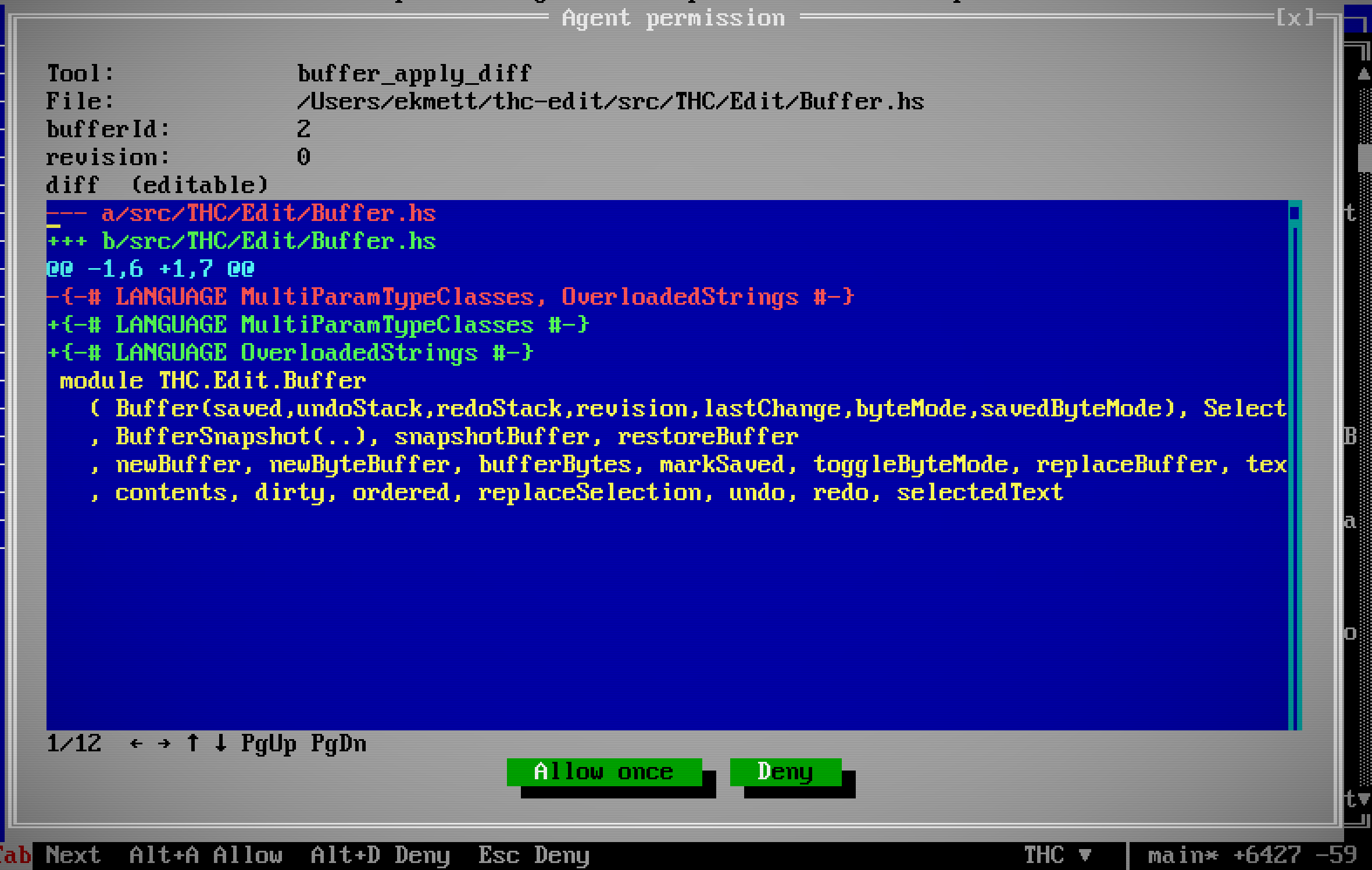
Allow validates the reviewed diff against the original captured source and checks that the live buffer is still that exact version before applying it atomically. Replacement is rejected even when text and numeric revision match, including while the request waits to begin. Stale requests require a fresh read and new request; editing the review never rebases its source. Invalid or stale edits remain open with an error and apply nothing. A successful prompted patch returns appliedDiff, userModified and the resulting revision, so the requesting agent sees the human's actual edit. The buffer remains unsaved; approval never writes the file to disk.
Use one buffers array for the whole edit, including a one-file edit. Each entry has its own bufferId, expected revision and strict unified diff. The batch accepts 1–16 distinct open text buffers and at most 1 MiB patch characters in total. Its approval shows one editable diff per file; Tab moves between them. Allow applies all changes together or none. One closed, private or stale target rejects the whole edit.
The reply is { "buffers": [...] } in request order. Each entry contains bufferId, the resulting revision, saved: false, appliedDiff and userModified. Each changed buffer has its own ordinary Undo entry.
A pending approval can be cancelled; cancellation does not undo an operation already executed. Questions return pending without waiting for the human. HLS and debugger reply waits release the desktop lock. After a disconnect or uncertain reply, inspect current state before retrying a mutation. IDs belong to the editor session.
External clients connect with hide --mcp-editor SESSION_ID. The bridge shares the session without taking over its display. Skills describe workflows; MCP tool schemas and host policy govern the actual calls.
Agents sidebar
Expand Agents in the shared sidebar to see agent names, parent relationships and current states. A leaf opens its existing conversation; an agent with children expands to show them and offers Conversation in its context menu. Rename starts with the current name selected, and keeps the captured agent ID while the directory changes. Resize and background label refresh preserve the draft and selection. Closing and reopening expires the old form; a delayed submission cannot rename through a closed registration or replace a newer dialog. Rename submission is human-only. Names remain unique.
Right-click Agents and choose New Agent to enter a name and task. This starts a fresh agent in the shared workspace where the dialog was opened and queues that task. If the workspace changes before submission, reopen the dialog. Creation and directory updates stay in the background and do not select another conversation. This requires a persistent editor session. Existing orchestration tools continue to support explicit fork/worktree choices.
Agent Model and Effort menus use the provider's advertised identifiers and values. Choice dialogs retain the exact agent and configuration; changed or reconnected targets refuse an old selection. Changing another agent's model does not select its conversation.
When ACP autocomplete is configured, ACP completion appears separately from Primary and subagents, including before its lazy connection starts. Selecting it reveals the same cached completion transcript. Closing that pane leaves completion running; revealing or hiding it preserves the warm connection. Its Model/Effort menus explicitly negotiate choices on that existing owner and persist accepted settings independently of the main conversation. Background sidebar refresh never starts a provider. Old completion/settings incarnations refuse stale choices.
Sessions, completion naming and fuller New Agent fork/workspace controls remain tracked in #7.